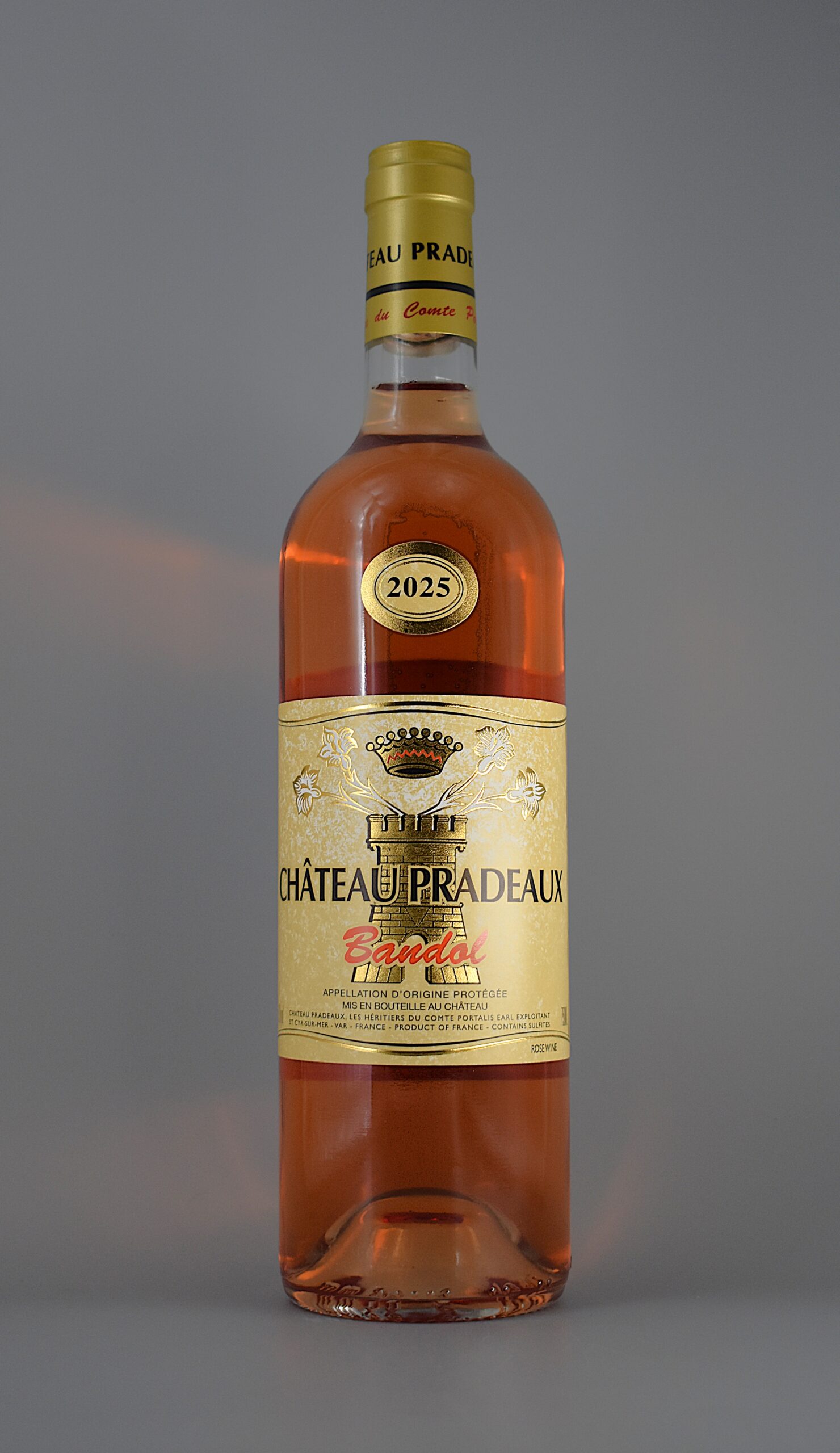
2025 Chateau Pradeaux Bandol Rosé

CRITIC SCORE:
“The 2025 Bandol Rosé is already showing beautifully, offering a medium-bodied palate wiht lovely drive and freshness, the latter especially impressive given the warmth of the vintage. There is a sense of poise here that sets it apart, combining Mediterranean sun with real structural discipline. This is precisely why great Bandol Rosé enjoys such a cult following – it is not merely refreshing, but serious and characterful with the depth to evolve in bottle. Few Rosés in the world occupy that space so convincingly, and this wine is a clear reminder of the category’s highest possibilities.
Étienne Portalis and his brother Édouard represent the ninth generation at Château Pradeaux, one of Bandol’s historic estates. The family has been in the region since 1750, and that sense of continuity remains central to the domaine’s identity. Today, the property covers 22 hectares of vineyards, planted to 80% Mourvèdre, 15% Cinsaut and the rest Grenache, Carignan, Counoise and a few other varieties. Production is modest at around 50,000 bottles annually (equally split between the Rosé and red categories), and the estate has been certified organic since 2023. Here, the vineyards benefit from constant marine influence and natural ventilation, with sea air circulating freely. The result is a cooler, windier environment than in warmer sectors of the appellation. At Pradeaux, Mourvèdre is understood as a patiently maturing and highly demanding variety that requires time at every stage, from ripening to extraction to élevage. That view shapes the estate’s understanding of Bandol itself. The appellation, established in 1941, was in part founded on the aim to restore Mourvèdre to prominence after the post-phylloxera shift toward more productive varieties such as Carignan. Some of the vines at Pradeaux are now around 70 years old, though the family is now renewing parts of the vineyard.
The distinctive house style is nowhere more evident than in the red Bandol, which is fermented with 100% whole bunches. After sorting, the fruit goes directly into vat, where fermentation lasts only 10 to 12 days. What follows is highly unusual by modern standards: maceration lasts up to eight weeks. This approach has evolved over time. Portalis moved away from the punchdowns that were common in the late 2000s, feeling the results were too tannic, especially given the presence of whole clusters. What followed was a gentler extraction regime built around infusion, with one pumpover per day, occasionally two. After malolactic fermentation, the wines spend four years in large foudres, far beyond the appellation minimum of 18 months. The philosophy is unwavering: give Mourvèdre the time it needs to knit itself together.
That patience defines the wine in the glass. These wines are not shaped for instant gratification, though they can be enjoyed young with a proper decant. While the beguilingly delicious 2020 Bandol Rouge was one of the highlights of my entire trip, Château Pradeaux also produces one of France’s most iconic Rosés, 70% of which is usually shipped to the US market. Make no mistake: Château Pradeaux is one of Bandol’s great treasures.”
PAIRS WITH:


$28.99/bottle
Regional Information About This Wine:
Lorem ipsum dolor sit amet, cu dicant praesent cum, id regione alienum quo, ei mollis admodum vix. Ut partiendo mediocritatem usu, id saepe facilis nec. No errem omnesque accommodare mea, vim et detracto senserit qualisque. Sit aperiri menandri definitionem at. Vel aliquam legimus ne.
Ex vix summo convenire, mei ad labores iracundia appellantur. In mel virtute scaevola, velit iriure postulant nam eu, docendi lucilius elaboraret quo ei. Ad mei putent doctus maluisset, ut epicuri patrioque sed. Mel te dicam adolescens.
Lorem ipsum dolor sit amet, cu dicant praesent cum, id regione alienum quo, ei mollis admodum vix. Ut partiendo mediocritatem usu, id saepe facilis nec. No errem omnesque accommodare mea, vim et detracto senserit qualisque. Sit aperiri menandri definitionem at. Vel aliquam legimus ne.
Ex vix summo convenire, mei ad labores iracundia appellantur. In mel virtute scaevola, velit iriure postulant nam eu, docendi lucilius elaboraret quo ei. Ad mei putent doctus maluisset, ut epicuri patrioque sed. Mel te dicam adolescens.
Lorem ipsum dolor sit amet, cu dicant praesent cum, id regione alienum quo, ei mollis admodum vix. Ut partiendo mediocritatem usu, id saepe facilis nec. No errem omnesque accommodare mea, vim et detracto senserit qualisque. Sit aperiri menandri definitionem at. Vel aliquam legimus ne.
Ex vix summo convenire, mei ad labores iracundia appellantur. In mel virtute scaevola, velit iriure postulant nam eu, docendi lucilius elaboraret quo ei. Ad mei putent doctus maluisset, ut epicuri patrioque sed. Mel te dicam adolescens.
Lorem ipsum dolor sit amet, cu dicant praesent cum, id regione alienum quo, ei mollis admodum vix. Ut partiendo mediocritatem usu, id saepe facilis nec. No errem omnesque accommodare mea, vim et detracto senserit qualisque. Sit aperiri menandri definitionem at. Vel aliquam legimus ne.
Ex vix summo convenire, mei ad labores iracundia appellantur. In mel virtute scaevola, velit iriure postulant nam eu, docendi lucilius elaboraret quo ei. Ad mei putent doctus maluisset, ut epicuri patrioque sed. Mel te dicam adolescens.
Reviews
There are no reviews yet.